
Introduction
Few voices in global economics carry as much weight during crises as Nouriel Roubini. Known for accurately warning about the 2008 financial collapse, Roubini is once again sounding the alarm this time about cryptocurrency.
In early 2026, as Bitcoin struggles and market confidence fades, Roubini argues that the crypto industry is approaching a “catastrophic end.” His message is blunt: even political support, regulatory softening, and years of technological promises have failed to deliver a stable or trustworthy financial system.
This article explores why Roubini believes the crypto experiment is breaking down and what that means for investors, policymakers, and the future of money.
A Pro-Crypto Era That Failed to Deliver
Only a year ago, optimism dominated the crypto narrative. A historically pro-crypto administration promised regulatory clarity, innovation, and mass adoption. Enthusiasts spoke confidently about Bitcoin reaching $200,000.
Reality turned out very differently.
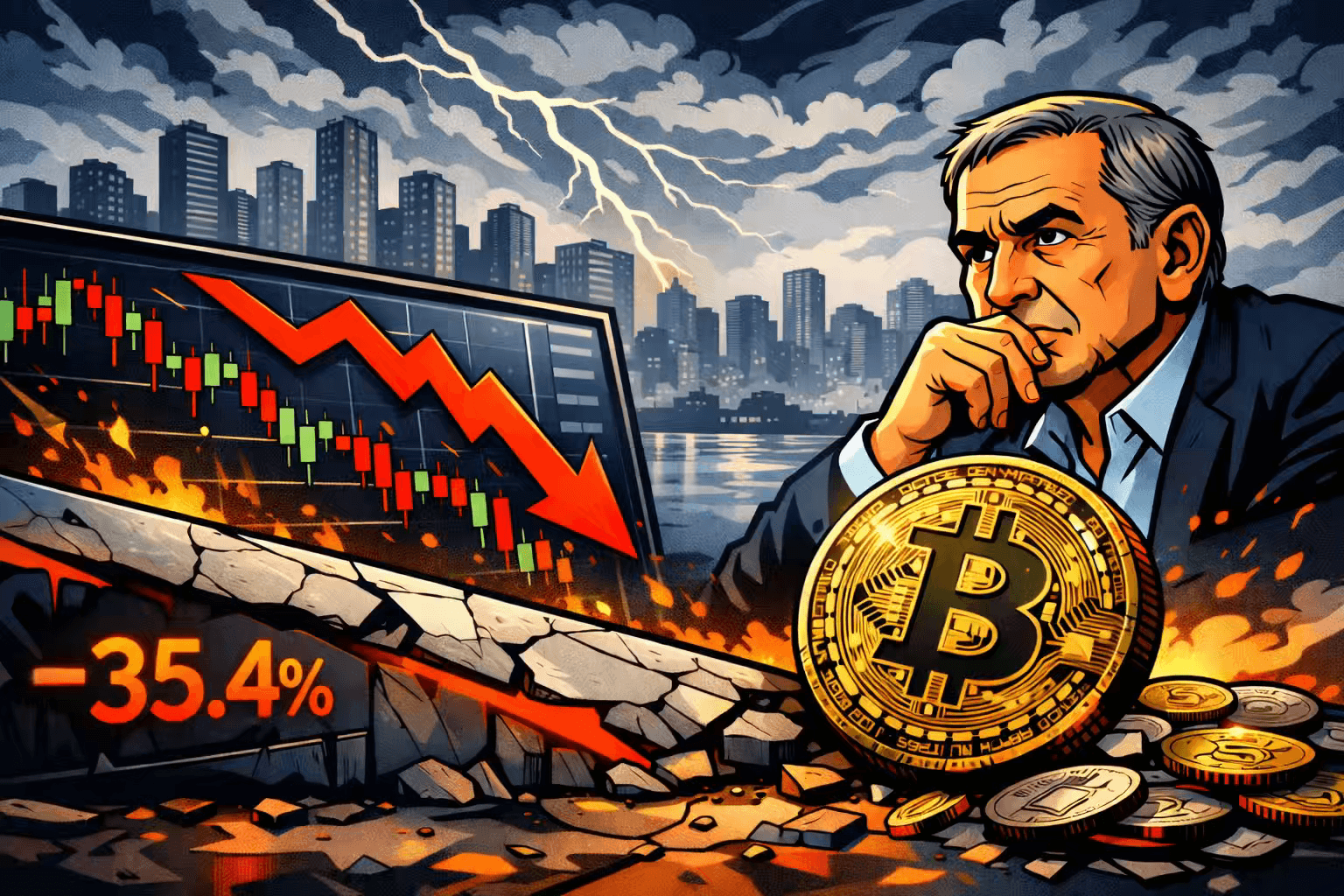
By February 2026, Bitcoin had fallen roughly 35% from its October peak, reaching its lowest levels since late 2024. Despite favourable rhetoric from policymakers, the market continued to weaken. For Roubini, this disconnect proves a deeper issue: crypto’s problems are structural, not political.
In his view, no amount of deregulation can fix an asset class that lacks real economic foundations.
Bitcoin vs Gold: The “Digital Gold” Narrative Breaks
One of Roubini’s strongest arguments targets Bitcoin’s role as “digital gold.”
Over the past year, gold prices rose more than 60%, fuelled by geopolitical instability, trade conflicts, and rising government debt. Bitcoin, by contrast, fell around 6% during the same period.
Roubini points out a consistent pattern: when global risk increases and gold rallies, Bitcoin often declines. Rather than acting as a hedge, he argues, Bitcoin behaves like a leveraged risk asset, amplifying volatility instead of protecting against it.
From this perspective, the store-of-value narrative collapses under real-world stress.
Why Roubini Believes the Crypto Experiment Is Ending
Roubini has long argued that calling crypto a “currency” is misleading. He believes it fails on all three core functions of money:
It is not a stable unit of account
It is inefficient as a means of payment
It is unreliable as a store of value
After nearly two decades, he claims the only genuine success story in crypto is the stablecoin largely because it mirrors traditional finance rather than replacing it.
Decentralised finance (DeFi), in his view, will never scale. Governments, he argues, will not allow the level of anonymity required for fully decentralised systems, as it enables crime, fraud, and regulatory evasion.
Instead, Roubini sees the future of money as a gradual evolution of traditional financial infrastructure, improved through better digital ledgers, stronger regulation, and state-backed systems not a crypto revolution.
AI-Powered Sentiment Analysis
Our AI analysis of this article revealed:
sentiment_score: 0.31 Overall emotional tone is cautious and pessimistic, reflecting fear and loss of confidence.
Financial Sentiment: –0.58 Strongly negative outlook on crypto markets, highlighting risk, underperformance, and systemic weakness.
Polarity Score: –0.42 Language leans clearly negative, with limited optimism or balance.
Subjectivity Score: 0.37 While opinionated, the article relies heavily on observable market data and historical comparisons.
These scores suggest that market sentiment around cryptocurrency in early 2026 is fragile and defensive. Fear is driven less by short-term price action and more by a growing belief that crypto’s long-term promise may have been overstated. The emotional backdrop is no longer speculative excitement, but uncertainty and reassessment.
Read More
👉 Read the full article on U.today.com
Hikari Nova is opening early access.
We’re building an automated trading system that simplifies decision-making. Instead of spending hours monitoring charts and signals, Hikari Nova sends actionable trade signals based on real market data, tested strategies, and ongoing optimisation.
We are now opening early access sign-ups.
✅ Early users will be invited first when we go live
✅ Early access pricing will be lower than the public launch price
✅ No commitment just register your interest
If you’d like to be part of the first group:
Disclaimer
This article was generated using AI and reviewed for accuracy. The information presented is for educational purposes only and should not be construed as financial advice. Always consult with a professional before making investment decisions.